

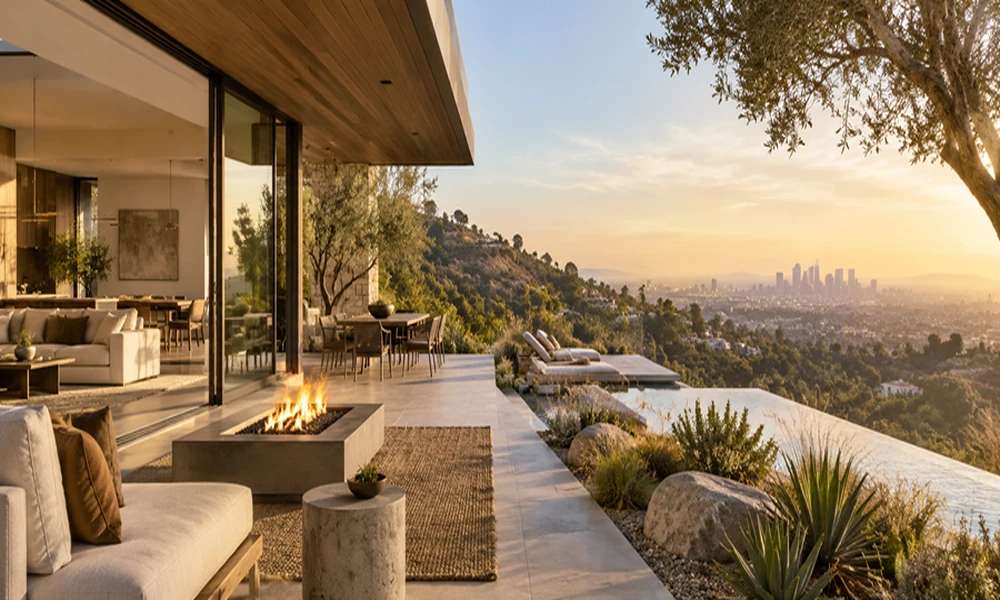
Memorable architecture rarely begins with a predetermined style. It begins with understanding the conditions a building has to respond to.
That distinction is particularly important in Los Angeles, where the needs of one property can differ substantially from those of another. A building may need to negotiate a sloped site, a compact urban parcel, an established residential neighborhood, significant indoor-outdoor connections, or environmental concerns that affect material and planning decisions.
For owners and developers, thinking about context early can prevent a project from becoming a collection of attractive ideas that do not work together. Four considerations deserve attention before a design direction becomes fixed.
Start With the Site, Not the Architectural Style
It is tempting to begin a project with images: a façade someone likes, a dramatic interior, or a recognizable architectural style.
Those references can be useful, but they should not dictate the project before the site has been understood.
Topography, orientation, access, neighboring properties, existing landscape, views, privacy, and circulation can all influence the appropriate form of a building. The strongest solution may therefore look very different from the owner’s original reference images while still delivering the qualities behind them.
A desire for openness, for example, does not necessarily mean maximizing glass everywhere. Depending on orientation and neighboring conditions, openness might instead be achieved through courtyards, carefully positioned openings, framed views, or connections to protected outdoor spaces.
This is why a useful early question is not simply, “What should this building look like?” It is, “What does this particular site make possible, and what problems does it ask the design to solve?”
The second question usually produces more durable ideas.
Treat Resilience as Part of Design
Performance considerations are most effective when they influence architecture from the beginning rather than being treated as additions after the main concept has been developed.
On a project where heat, intense sun, wind, wildfire exposure, water use, or other environmental conditions are concerns, decisions about orientation, landscape, openings, exterior materials, shade, and building form can become part of the architectural concept itself.
That does not require sacrificing visual character.
In many cases, a constraint gives a project its identity. A need for shade can influence depth and massing. Privacy requirements can produce more deliberate openings. A challenging slope can generate an unusual relationship between levels. Material requirements can establish texture, rhythm, or visual continuity.
Owners should therefore ask design teams how they identify project risks and opportunities early in the process. The goal is not simply to receive a checklist of technical responses. It is to understand whether practical constraints and architectural thinking are being developed together.
Choose a Design Team That Can Connect the Pieces
Selecting an architect should involve more than finding a portfolio with attractive photographs.
Online research may begin with broad searches such as architecture firms Los Angeles, but a useful shortlist should ultimately be based on evidence that a team can address the particular conditions of the proposed project.
Look closely at how previous projects respond to their sites. Examine whether the portfolio contains challenges comparable to yours-not necessarily buildings that look similar, but projects involving similar levels of complexity.
Then investigate the process.
How does the team move from the client’s goals to a design concept? How are engineering, construction, materials, landscape, and other disciplines considered? How are competing priorities evaluated when the ideal aesthetic solution conflicts with budget, constructability, privacy, performance, or site limitations?
A polished finished building shows the result of architectural work. Understanding the reasoning behind it reveals considerably more about how the architects might approach a new project.
That distinction is important because clients do not purchase portfolio photographs. They enter a design and construction process that may involve hundreds of interconnected decisions.
Design for Daily Experience, Not Just the Exterior
Architecture is often encountered first through exterior photographs, but a building is experienced differently by the people who use it every day.
Consider the sequence of arriving, entering, moving between rooms or program areas, encountering natural light, seeing the landscape, finding privacy, gathering with other people, and moving between indoors and outdoors.
These everyday experiences should be discussed as seriously as exterior appearance.
For a residence, that could mean considering how formal entertaining coexists with ordinary family routines. For a cultural or educational project, circulation may need to work for different groups using the building in different ways. For multifamily or mixed-use projects, the transition between public, shared, and private space can influence how comfortable the building feels.
Thinking this way also makes programming more useful.
Instead of listing only the rooms or spaces required, owners can describe relationships: which spaces should connect, which should remain separate, where quiet is important, what should receive natural light, and how people should experience the building throughout the day.
Those observations give an architect considerably more meaningful information than a collection of visual references alone.
Conclusion
Good architecture is not created by solving aesthetics, site planning, performance, and human experience as separate exercises. The most coherent projects allow those considerations to inform one another.
For anyone planning a building project, that means the earliest conversations should explore more than appearance. Understand what is distinctive about the site, identify the conditions the building needs to address, think carefully about how people will actually use the spaces, and evaluate architects according to how they solve problems rather than how closely their previous work resembles a desired style.
A building that grows from its context has a better foundation for becoming something more valuable than a visually impressive object: a place whose design makes sense for where it is, what it needs to do, and the people who will use it.
