

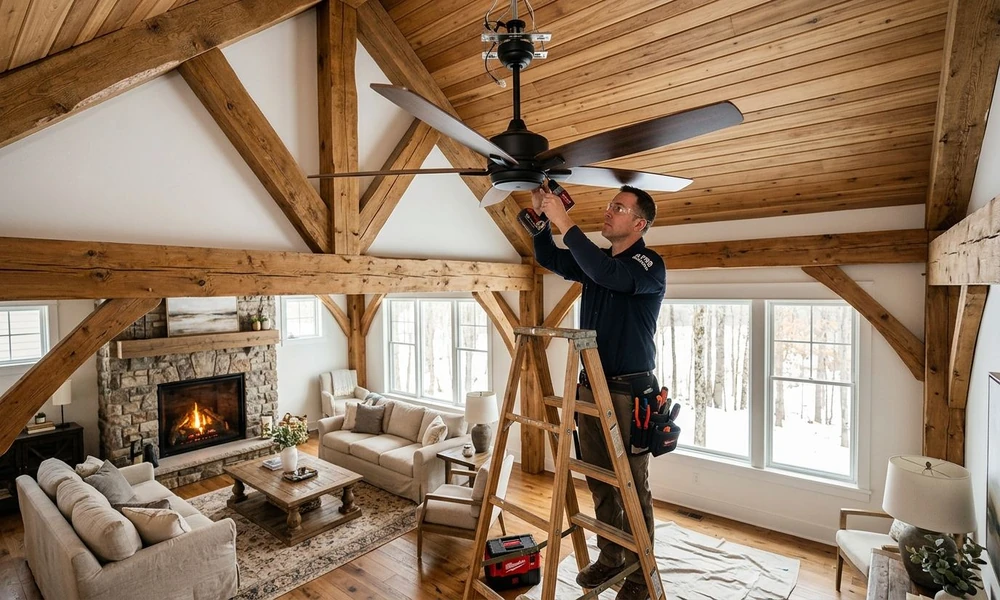
A spacious living room with high ceilings can make a home feel open, bright, and inviting. However, when an older ceiling fan starts making noise, the lighting looks outdated, or the fan speed becomes difficult to adjust, upgrading the fixture can be more complicated than it first appears. Reaching the fan may require a tall ladder, the existing wiring might not support separate fan and light controls, and choosing the right smart technology can take some planning.
For homeowners in San Marcos, Texas, modern ceiling fans offer an opportunity to improve comfort, update a living room’s appearance, and make everyday lighting easier to manage. Today’s smart fans can combine energy-efficient LED lighting, adjustable speeds, remote operation, and compatibility with selected home automation systems. With the right setup, you can change the lighting or adjust airflow without walking across the room or climbing a ladder to reach a wall switch.
San Marcos homeowners looking to modernize their living rooms with smart ceiling fans, automated lighting, and convenient remote controls can rely on Tejas Electric for professional smart home installation tailored to their home’s layout and electrical needs.
Whether you’re renovating a home near Texas State University, updating a property in an established San Marcos neighborhood, or improving a house in one of the area’s growing residential communities, a smart ceiling fan can be a practical upgrade. The key is selecting compatible equipment and making sure the electrical connections, ceiling support, and controls are suitable for the installation.
Why Upgrade an Older Ceiling Fan in a High-Ceiling Living Room?
Older ceiling fans can remain functional for years, but that doesn’t mean they provide the comfort, lighting quality, or convenience homeowners want today. A fan that operates through a basic pull chain may be particularly inconvenient when it’s mounted well above normal reach.
Modern smart ceiling fans address several common problems. Many models feature integrated LED lighting, multiple fan speeds, dimming capabilities, and remote controls. Some can also connect to a compatible smartphone app or voice assistant, allowing homeowners to make adjustments from a sofa, dining area, or another room.
The benefits go beyond convenience. Replacing an outdated fan can help bring a living room’s appearance in line with other home improvements. A contemporary fixture may complement updated flooring, new furniture, recessed lighting, or fresh interior paint.
For San Marcos homeowners, the right ceiling fan can also help circulate air in rooms with vaulted ceilings. Because warm air tends to rise, the room’s temperature can feel uneven depending on the season, ceiling height, and HVAC system. A properly sized fan with appropriate airflow settings can improve air movement and make the space feel more comfortable.
Before selecting a replacement, consider the room’s square footage, ceiling height, existing electrical setup, and the features you want to use regularly. Tejas Electric can help homeowners evaluate the electrical side of the upgrade and determine what may be needed to support the new fixture and its controls.
Replacing an Outdated Fan With a Smart Fan and Integrated LED Lighting
One of the most noticeable improvements is replacing an older ceiling fan and separate light kit with a modern model that combines the two functions in one fixture.
Integrated LED lighting offers several advantages. LEDs generally consume less electricity than traditional incandescent bulbs, produce less heat, and often last longer. Many smart fan models also allow users to adjust brightness and, depending on the product, choose between different color temperatures.
For example, a San Marcos family might prefer bright, neutral lighting for reading, cleaning, or helping children with homework. In the evening, dimmer, warmer lighting may create a more relaxed atmosphere for watching television or entertaining guests.
A smart fan with integrated lighting can make these adjustments easier, provided the selected model supports the desired features.
However, not every smart ceiling fan works the same way. Some fixtures have built-in LED modules rather than replaceable bulbs. Others offer dimming through a proprietary remote or a compatible control system. Certain models support smart-home platforms, while others operate only through their included remote.
Before purchasing a fan, review its specifications carefully. Confirm that the fixture provides the required airflow, lighting output, dimming options, and control compatibility.
It’s also important to check the fan’s physical dimensions. A large fan may be appropriate for an expansive living room but could overwhelm a smaller space. The mounting arrangement, blade clearance, and distance from the floor should also be considered.
Choosing Smart Controls for Ceiling Fans That Are Beyond Easy Reach
A ceiling fan mounted 12, 16, or even 20 feet above a living room floor creates a practical challenge. Reaching a pull chain or operating a control located in an awkward position is inconvenient, especially for households that regularly adjust both airflow and lighting.
Smart controls eliminate much of that frustration.
Depending on the fan model, homeowners can choose from several options:
- Handheld remote controls: A convenient solution for changing fan speed and light settings from anywhere within the remote’s operating range.
- Wall-mounted controls: Useful for homeowners who prefer a dedicated control near the living room entrance.
- Smartphone apps: Allow adjustments through a compatible mobile device, sometimes including access when away from home.
- Voice control: Enables hands-free operation through a supported voice assistant and compatible smart-home configuration.
- Automation routines: Adjust selected settings automatically according to a schedule or another supported trigger.
The best option depends on how the room is used. A family that primarily wants to adjust fan speed from the couch may be satisfied with a remote. Someone who wants the fan integrated with a larger smart-home setup may prefer app control and automation.
Compatibility matters, though. A smart fan does not automatically support every app, voice assistant, or home automation platform. Some products require a dedicated hub, while others connect directly to a home Wi-Fi network or another supported wireless system.
Before buying a control system, verify that the fan, receiver, wall control, and smart-home platform are designed to work together.
App-Based and Voice-Controlled Operation for Everyday Comfort
Imagine settling into your living room after a warm afternoon in San Marcos, Texas. Instead of searching for a remote or trying to reach a wall switch, you open an app and lower the fan speed. If your system supports voice commands, you can make the same adjustment without picking up your phone.
That convenience is one of the main reasons homeowners consider smart ceiling fan installation.
App-based controls can provide access to fan speed, lighting brightness, and other supported features. Some systems also allow users to create favorite settings or manage multiple devices from one interface.
Voice control can be especially helpful when your hands are occupied or you want to adjust the room without interrupting an activity. You might turn on the living room light before entering, reduce brightness during a movie, or change the fan speed while preparing for guests.
These features depend on the equipment selected. Some fans support voice commands natively through their connected platform, while others require a compatible bridge or smart controller.
Reliable operation also depends on the home’s network and the manufacturer’s setup requirements. If the system relies on Wi-Fi, the fan’s location and the strength of the wireless signal may affect performance.
Tejas Electric can help homeowners plan the electrical installation around the selected equipment. For app and voice features, it’s important to follow the manufacturer’s requirements and confirm that the necessary devices and network connections are in place.
Evaluating Existing Wiring for Separate Fan and Light Controls
Before replacing a ceiling fan, it’s worth examining how the existing wiring is configured.
Older installations sometimes use a single wall switch to control both the fan and its light. In other homes, the fan and light have separate switches, making independent operation more straightforward.
If the existing installation has only one switched circuit serving both functions, the ability to add separate wall controls may depend on the wiring between the switch and the ceiling box. The presence of a suitable neutral conductor, available conductors, grounding, and other circuit conditions may also affect the options.
This is important because many homeowners want to operate the light without running the fan, or adjust the fan without changing the lighting.
Depending on the existing wiring and the new fan’s design, several solutions may be possible:
- Use a manufacturer-approved remote receiver that independently controls the fan and light.
- Install a compatible wall control that communicates with the fan’s receiver.
- Use existing separate switched conductors when the wiring and equipment support that arrangement.
- Have an electrician evaluate whether additional wiring is necessary or practical.
A remote receiver may offer independent control without requiring separate switched conductors, but that depends on the fan and receiver combination. It should not be assumed that every fan can be converted to independent wall-switch operation without wiring changes.
A qualified electrician can inspect the existing connections, verify the circuit arrangement, and explain which options are appropriate for the installation.
Installing Compatible Wall Controls, Receivers, and Remote Systems
The control system is just as important as the fan itself. Selecting an attractive fixture won’t deliver the expected convenience if the controls are incompatible or difficult to use.
A receiver is often installed in the fan’s canopy, where it connects according to the manufacturer’s wiring diagram. The receiver communicates with the included remote or a compatible control system, allowing the fan’s motor and light to operate independently when supported.
Some smart fans have integrated electronics and do not need a separate receiver. Others require a specific accessory for app-based or voice-controlled operation.
Wall controls also vary. Some are designed to replace a conventional wall switch, while others communicate wirelessly with the fan. A standard light dimmer should not be used to control a ceiling fan motor unless the equipment is specifically designed and listed for that purpose.
Using an incompatible control can cause poor performance, buzzing, flickering, overheating, or equipment damage.
The installation should also preserve safe electrical connections, appropriate grounding, and compliance with the applicable electrical requirements. Any changes to wiring need to account for the existing circuit and the manufacturer’s instructions.
For homeowners who want a clean, finished result, professional installation can help ensure that the control arrangement is both practical and compatible with the selected fixture.
Scheduling and Automation for More Consistent Comfort
Smart ceiling fans become particularly useful when homeowners take advantage of scheduling and automation features.
Instead of manually adjusting the fan several times a day, you may be able to create routines that match your household’s schedule.
For example, a family could program the living room lights to turn on at a set time in the evening, provided the system supports scheduled lighting. The fan could be set to a preferred speed before the family settles down for the night.
Other possible routines include:
- Morning lighting: Turn on selected lights at a scheduled time to make the living room brighter at the start of the day.
- Evening relaxation: Reduce light brightness to a preferred level for watching television or reading.
- Consistent fan settings: Use a preferred speed during regularly scheduled periods when the living room is occupied.
- Away-from-home control: Use supported remote access to check or adjust connected devices while away.
- Combined routines: Coordinate the fan and compatible lights through a single scene or automation.
Not every fan supports every automation feature, and some routines require a particular app, hub, or smart-home platform. It’s best to confirm the available functions before purchasing the equipment.
Homeowners should also consider whether automated settings will genuinely make everyday life easier. A simple remote may be enough for some households, while others will appreciate having the fan and lighting work together with the rest of their connected home.
Coordinating Smart Ceiling Fans With Other Smart Lighting
A smart ceiling fan doesn’t have to operate as an isolated device. When compatible equipment is selected, it can become part of a broader living room lighting and home automation plan.
For example, a homeowner might combine a smart fan with recessed LED lighting, smart lamps, accent lighting, or compatible wall switches. A single scene could activate several lights at once, while another could dim them for a quieter evening.
The result can feel more cohesive than installing smart devices one at a time without considering how they interact.
Still, compatibility should be checked at the product level. Two devices may both be advertised as smart products without supporting the same app, wireless standard, or automation platform.
It’s also worth considering how the lighting will be controlled when the internet is unavailable or a phone isn’t nearby. Depending on the product, a physical wall switch or included remote may provide a useful backup.
Tejas Electric can assist with the electrical installation of compatible fans, lighting fixtures, and controls, helping homeowners plan upgrades that make sense for their living room rather than treating each device as a separate project.
Checking Ceiling Support, Electrical Boxes, and Mounting Hardware
A smart ceiling fan upgrade involves more than connecting wires. The fan must also be mounted securely to a ceiling structure that can support its weight and the movement produced during operation.
This becomes especially important when replacing a lightweight fixture or installing a larger fan in a high-ceiling room.
A conventional light-fixture electrical box may not be rated for ceiling fan support. The installation needs an appropriately rated fan-support box or another approved mounting arrangement secured to suitable framing or structural support.
The mounting hardware must match the fan’s requirements, and the bracket needs to be installed according to the manufacturer’s instructions.
Additional considerations include:
- Confirming that the electrical box is rated for ceiling fan support.
- Inspecting the mounting bracket and hardware for compatibility.
- Checking the condition of existing wiring and electrical connections.
- Verifying that the fan’s blades have appropriate clearance from walls, beams, and other obstructions.
- Selecting a downrod or mounting system suitable for the ceiling height and fan model.
- Ensuring that the fan is securely installed and properly balanced.
A high ceiling can make these checks more difficult because the mounting point may be hard to inspect closely. An existing fan’s successful operation doesn’t necessarily prove that its box, wiring, or mounting hardware is suitable for a different replacement model.
Before upgrading, have the mounting arrangement evaluated rather than assuming the old installation can support any new fan.
Is Smart Ceiling Fan Installation a Good DIY Project?
For homeowners who enjoy working on their houses, replacing a ceiling fan may look like a manageable weekend project. Some straightforward replacements can be relatively simple for people with the right experience, tools, and understanding of the manufacturer’s instructions.
However, a tall living room changes the equation.
Working above a staircase, over furniture, or near a vaulted ceiling can create additional fall hazards. A larger fan may be awkward to lift and position, and a second person may be needed to hold the fixture while it is secured. Electrical work becomes more complicated if the existing wiring is old, the electrical box is unsuitable, or separate fan and light controls need to be added.
Smart fans introduce another layer of complexity because the receiver, wall control, motor, and light may need to be connected in a specific configuration.
For high-ceiling installations involving new wiring, modified circuits, electrical box replacement, or unfamiliar connections, hiring a qualified electrician is the safer and more reliable choice.
Homeowners should never work on energized wiring. Turning off the wall switch alone is not sufficient; the circuit must be de-energized at the breaker and verified before work begins. Even then, a person without appropriate electrical knowledge may not recognize an unsafe connection or an incorrectly supported fan.
Texas electrical licensing requirements also matter. Electrical work that falls within regulated electrical contracting must be performed by appropriately licensed professionals, subject to applicable exemptions and local requirements. A homeowner should not assume that every electrical modification is permitted as a DIY project.
If you are considering replacing a fan in a tall living room, consult a licensed electrical contractor familiar with the requirements in San Marcos, TX. A professional can assess the mounting location, electrical connections, control options, and scope of work before the installation begins.
Why Professional Installation Matters for Tall Living Rooms
A ceiling fan mounted close to a standard-height ceiling is generally easier to reach and inspect than one suspended high above a large living room. When the fixture is difficult to access, even routine maintenance or troubleshooting can become a challenge.
Professional installation helps address the practical concerns that come with these spaces.
An electrician can inspect the existing electrical box, assess the wiring configuration, and determine whether the selected fan can use the current connections. If a new control system is needed, the electrician can evaluate whether the proposed arrangement is compatible with the fan and the existing circuit.
Proper mounting is equally important. The fan must be secured to an appropriate support, with hardware suited to the model and ceiling configuration. If the existing setup is inadequate, it may need to be corrected before the new fixture is installed.
A professional can also help avoid common compatibility problems, such as connecting a motor to an unsuitable dimmer or selecting a control system that cannot independently operate the fan and light.
For San Marcos homeowners, these details can make the difference between a smart ceiling fan that works reliably and an upgrade that requires additional troubleshooting later.
Tejas Electric provides electrical services for homeowners looking to improve the functionality and comfort of their living spaces. When planning a smart ceiling fan upgrade, discussing your ceiling height, preferred controls, and existing electrical setup can help establish the right approach for your home.
Modernize Your San Marcos Living Room With Smarter Fan Controls
A modern ceiling fan can do much more than move air. With integrated LED lighting, a compatible remote, app-based controls, or voice operation, it can make a high-ceiling living room more comfortable and convenient throughout the year.
The best results start with careful planning. Choose a fan that fits the room, confirm that its controls work with the features you want, and make sure the electrical box and mounting hardware can safely support the fixture. If the existing wiring limits your options, have the installation evaluated before purchasing equipment.
While some basic fixture replacements may be manageable for experienced homeowners, high ceilings, difficult access, and changes to electrical wiring are strong reasons to seek professional help.
The licensed electricians from Tejas Electric can help San Marcos homeowners plan electrical upgrades that support modern living, from smart ceiling fan installations to compatible lighting and control improvements. With the right equipment and a properly planned installation, your living room can become easier to manage, more comfortable, and better suited to the way your family uses the space.
If you’re ready to replace an outdated fan or explore smart controls for a vaulted living room, contact Tejas Electric to discuss your home’s electrical needs and determine the best next step for your San Marcos property.
